The short answer
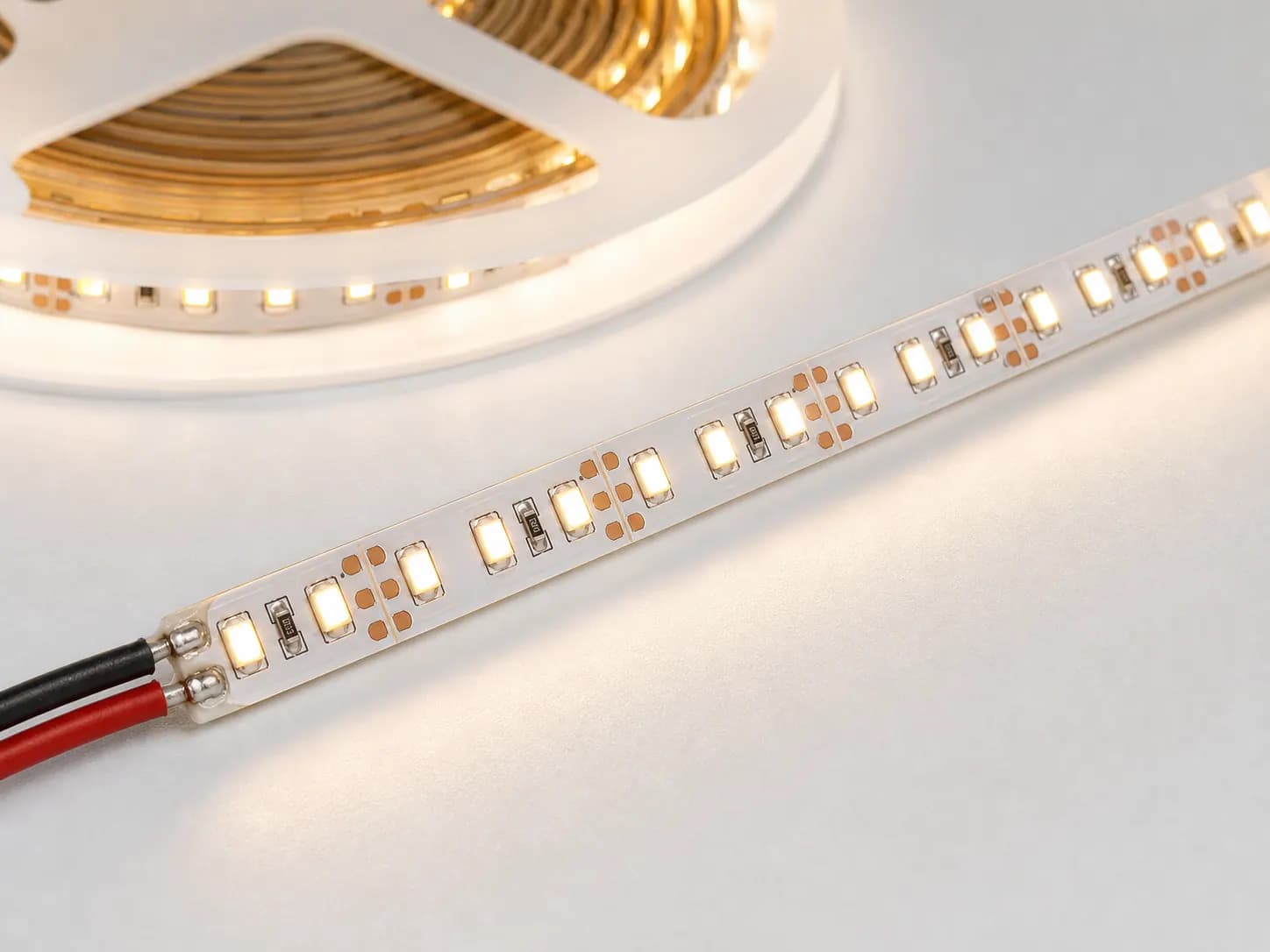
LED strip lights connect to a matching power supply through the positive and negative pads, or through a compatible connector. RGB and RGBW strips also need matching controller channels.
For stable project use, the connection method should be chosen together with voltage, wattage, run length, IP rating and installation access.
Start with voltage and polarity
The power supply voltage must match the strip voltage, such as 12V or 24V. A 24V strip should not be connected to a 12V supply if full brightness is required, and a 12V strip should not be connected to 24V.
Polarity also matters. For single-color strips, connect positive to positive and negative to negative. If the strip does not light, disconnect power before checking the wiring.
Connector or soldering
Clip-on connectors are convenient for quick installation and sample testing, but they must match PCB width, pad position, LED density and waterproof type.
Soldering usually gives a stronger connection for long-term projects, narrow strips, COB strips, high-density strips or places where vibration and movement may affect a clip connector.
Connecting two strip sections
Two LED strip sections can be joined with a strip-to-strip connector, short cable connector or soldered wire. The copper pads must align correctly and the connection should not create mechanical stress.
For corners, shelves and display cabinets, short jumper wires can make the installation cleaner than forcing the strip to bend sharply.
Power supply sizing
Calculate total power by multiplying strip wattage per meter by total length, then add reserve capacity for the driver. Many projects use a power supply with margin instead of running at full load.
For example, a 10 meter run at 10 W/m uses about 100 W before reserve. The final driver choice also depends on local standards, dimming method, installation space and heat.
Long runs and voltage drop
Long LED strip runs may become dimmer at the far end if current, cable length or strip resistance is too high. Power injection or separate feeds may be needed.
24V strips are often easier for longer runs than 12V strips because they can carry the same power with lower current. The best plan still depends on wattage, cable size and driver position.
RGB and controller connections
RGB, RGBW and tunable white strips require a controller that matches the strip type and voltage. The channel order should be checked before installation because wiring order can vary.
For commercial projects, confirm controller capacity, dimming protocol, remote or app control requirement, and whether different zones need separate control.
Quotation checklist
Send the supplier total length, voltage, wattage target, control method, drawing, power supply position, IP rating, connector preference and whether field cutting is expected.
For OEM or distributor orders, also confirm connector packing, cable length, label information and whether accessories should be supplied as a kit.
FAQ
How do you connect LED strip lights to a power supply?
Match the strip voltage, connect positive and negative correctly, and size the power supply for total wattage with reserve capacity.
Is soldering better than LED strip connectors?
Soldering is often stronger, while connectors are faster. The better choice depends on strip type, installation access and project reliability needs.
Can you connect multiple LED strips together?
Yes, but long or high-power runs may need power injection, larger wire or separate feeds to reduce voltage drop.