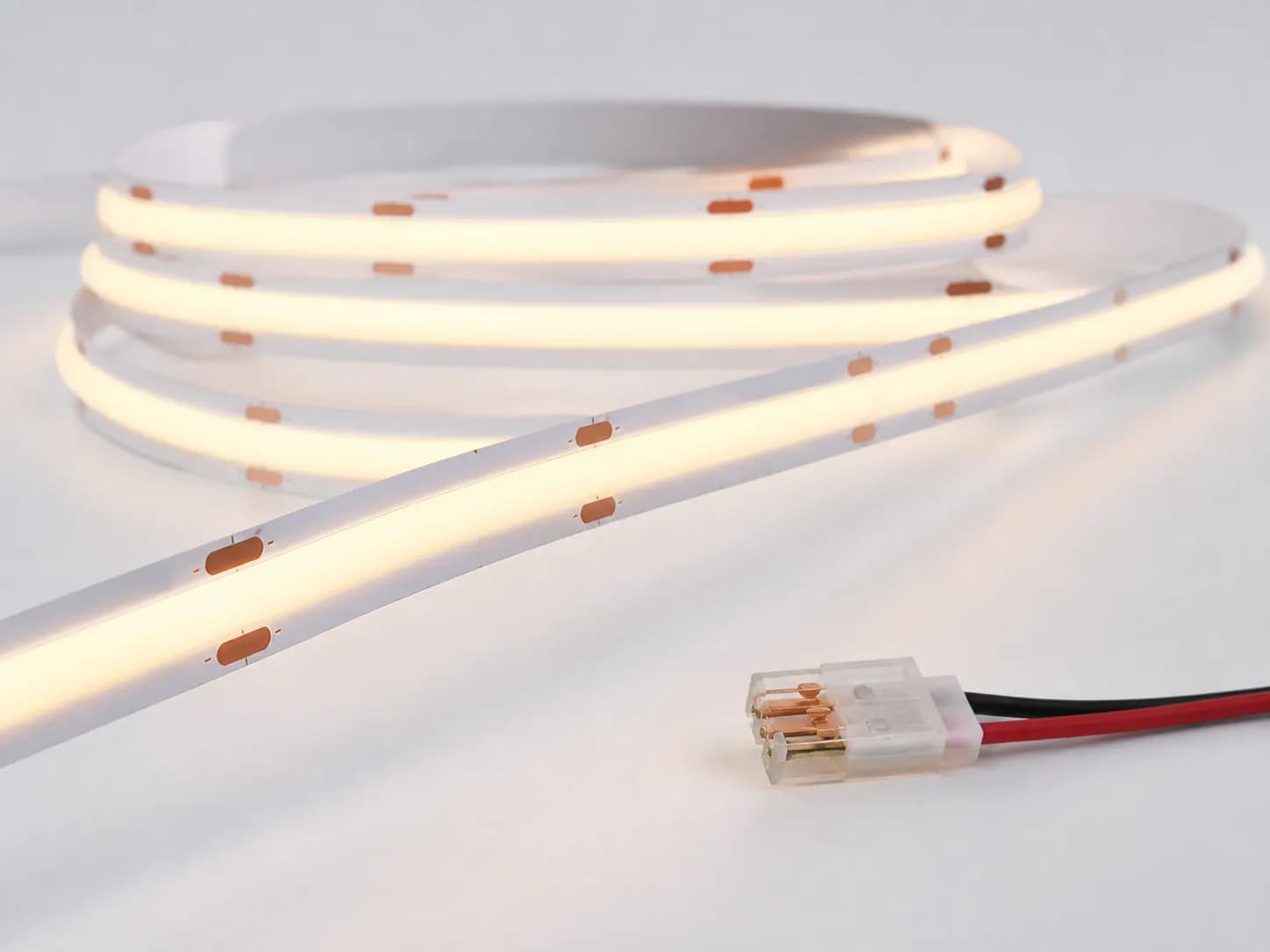
The main visual difference
COB LED strip lights are often selected for smoother, more continuous light output. They can reduce visible dots, especially in shallow profiles or exposed decorative lines.
SMD LED strips remain widely used because they offer many power, density, color and cost options for cabinets, shelves, signage and architectural details.
When COB is a good fit
COB is useful when the buyer wants a clean line of light, dot-free appearance or smoother output in a compact profile. It is often used for furniture, display shelves, decorative profiles and premium interiors.
Buyers should confirm cutting unit, width, IP rating, CCT, CRI and whether the COB version meets the required brightness.
When SMD remains practical
SMD strips are flexible for many price points and technical requirements. They are available in common LED packages, multiple voltages, RGB/RGBW, tunable white and high-output versions.
For high brightness, special color control, long runs or established repeat orders, SMD may still be the most practical sourcing option.
How to compare samples
Do not compare only product photos. Test samples in the actual profile or installation distance. Check light uniformity, color consistency, heat, adhesive performance and dimming compatibility.
For distributors, keep sample labels and batch references clear so that future bulk orders match the approved version.
Cost and stock considerations
COB LED strip can be a strong choice for premium visual projects, but SMD LED strip may offer more mature stock options, more power levels and faster replacement matching in some markets.
For distributors, the best catalog often includes both: COB for smooth-line projects and SMD for general cabinet, shelf, signage and high-output requirements. This makes sample selection easier for different customer budgets.
Questions to ask before sample approval
Ask whether the sample is the same width, voltage, CCT, CRI, adhesive, IP rating and LED density that will be used for bulk production. Small changes can affect brightness, color appearance and installation fit.
If the strip will be dimmed, tested in a shallow profile or used in a visible decorative line, request sample testing with the actual diffuser, controller and power supply whenever possible.
How to choose for different applications
For visible decorative lines, furniture grooves and shallow aluminum profiles, COB is often easier to approve because it reduces dotting. For high-output shelves, signage, RGB effects or cost-sensitive repeat orders, SMD options may provide more flexibility.
For retail and hospitality projects, ask for CRI and CCT consistency records. A smooth COB line still needs stable color, while an SMD strip with high CRI can be the better choice when product color accuracy matters.
Distributor catalog strategy
Distributors do not need to replace every SMD product with COB. A practical catalog can include COB for premium linear effects, SMD2835 for general white lighting, RGB/RGBW SMD for color projects and high-density versions for special brightness needs.
When building a sample box, label each strip with voltage, wattage, CRI, CCT, width and IP rating. This helps sales teams compare products accurately and prevents customers from choosing based only on appearance in a photo.
Side-by-side comparison for samples
A useful sample comparison should include the same CCT, similar wattage per meter, the same profile and the same diffuser. If the COB sample is tested in a better profile than the SMD sample, the result will not be fair.
Record visible dots, light smoothness, heat, color shift, dimming response, adhesive performance and minimum cutting unit. These notes help buyers choose the right version for repeat projects instead of relying on a single visual impression.
Final recommendation
Choose COB when the project needs a smoother visible line, shallow-profile installation or premium decorative appearance. Choose SMD when the buyer needs more options for brightness, color control, cost level, waterproof grade or established repeat supply.
The best decision comes from sample testing in the real profile or display distance. Compare uniformity, heat, adhesive, dimming and color consistency before locking the model for bulk production.
FAQ
Is COB LED strip always dot-free?
It is generally smoother than many SMD strips, but the final appearance still depends on profile depth, diffuser and viewing distance.
Is COB more expensive than SMD?
Often yes, but the exact difference depends on power, width, IP rating and order quantity.
Which is better for retail shelves?
Both can work. COB gives smoother lines, while high-CRI SMD can be practical for brightness and repeatable display lighting.