Voltage-system decision guide
| Decision factor | 12V evaluation | 24V evaluation |
|---|---|---|
| Circuit and cut plan | Check whether the exact model and cut interval suit short zones | Check whether the exact model suits the planned circuits |
| Current and cable route | Calculate current for every feed | Calculate current for every feed; do not assume voltage alone solves the route |
| Controls | Verify controller and supply voltage | Verify controller and supply voltage |
| Approval | Test a representative sample circuit | Test a representative sample circuit |
Bounded evaluation workflow
- Confirm the exact strip voltage, W/m, cut interval, and wiring from its current datasheet.
- Draw installed lengths, cable routes, branch circuits, and feed points.
- Calculate connected load and current for each circuit.
- Have the responsible designer verify conductor selection, protection, and voltage drop.
- Build a representative sample and record input and end-point voltage under the intended load.
A higher nominal voltage can reduce current for the same power, but actual run performance depends on the strip construction and complete circuit. Do not copy a maximum length from another product.
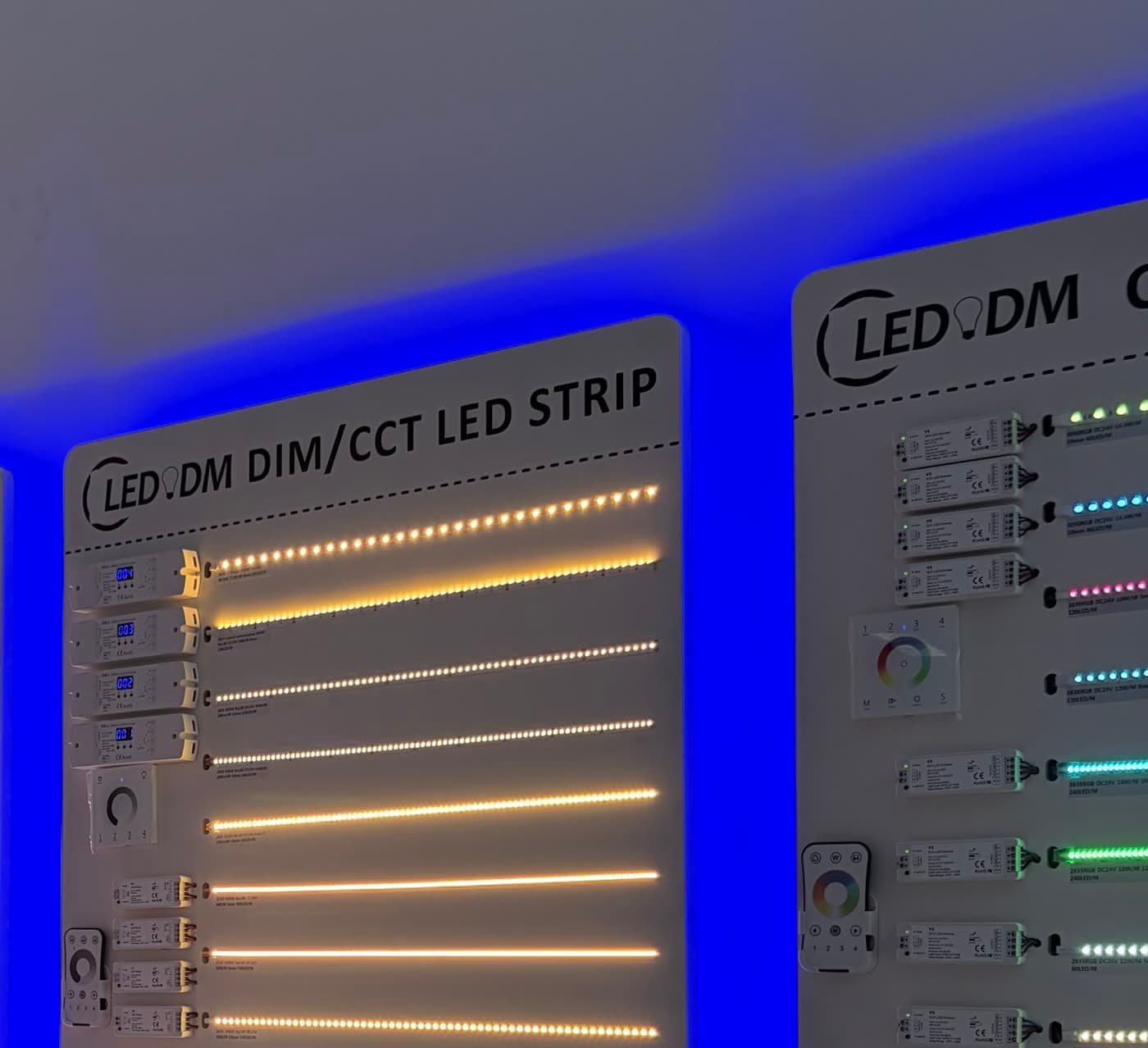
The image is a visual product reference, not performance evidence. Approve the documented circuit and representative sample.
FAQ
Is 24V COB always better than 12V?
No. The correct choice depends on the exact strip, circuit, feed arrangement, control equipment, and verified voltage-drop result.
What is the maximum COB strip run?
There is no universal maximum. Use the current datasheet and verify the intended circuit under load.
Can 12V and 24V strips share one power supply?
Not on the same fixed-voltage output. Each strip circuit must receive its rated voltage through compatible equipment.