Aluminum-channel decision guide
| Decision factor | Channel is more likely useful | Channel may be unnecessary only when |
|---|---|---|
| Thermal path and heat transfer | Whether a profile is required depends on the strip, duty, environment, and mounting interface; when selected, it must form a suitable path to the supporting surface | Product instructions and operating conditions permit the planned surface |
| Mounting surface | The substrate is uneven, delicate, or needs a defined fixing method | The surface is compatible, stable, clean, and approved for the strip |
| Protection | The strip needs shielding from contact or incidental mechanical exposure | The installed location already provides suitable protection |
| Diffuser and appearance | The diffuser controls optical appearance and can provide cover protection; it is distinct from the aluminum profile's thermal and mechanical path, and neither substitutes for the other | The exposed strip appearance meets the brief without that separate optical-cover role |
| Internal width and depth | The profile fits the strip, cable entry, and optical mixing space | No profile is part of the specified assembly |
Bounded fit-evaluation workflow
- Record strip width, power, construction, duty cycle, mounting surface, environment, and manufacturer instructions.
- Measure channel internal width and depth, not only its external dimensions, and allow for cable entry and connectors.
- Map each corner, bend, joint, end cap, fixing point, and maintenance-access constraint.
- Test fit a representative sample of strip, adhesive or mounting method, channel, diffuser, end cap, and cable.
- Operate the sample under representative conditions and record fit, surface condition, appearance, and accessible temperatures according to the project method.
| Sample check | What to inspect | Decision record |
|---|---|---|
| Mechanical fit | Internal width and depth, cable exit, connectors, end caps | Accepted component codes and assembly drawing |
| Corner and bend | Strip bend direction, joint position, diffuser continuity | Approved corner detail and installation sequence |
| Assembly operation | Mounting adhesion, heat transfer path, surface condition, protection | Test setup, operating condition, observations, and project acceptance |
The aluminum body can support a thermal path and mechanical mounting. A diffuser changes optical appearance and provides a cover; it is distinct from, and not the same as, the metal heat-transfer path. Neither role should be inferred from the other.
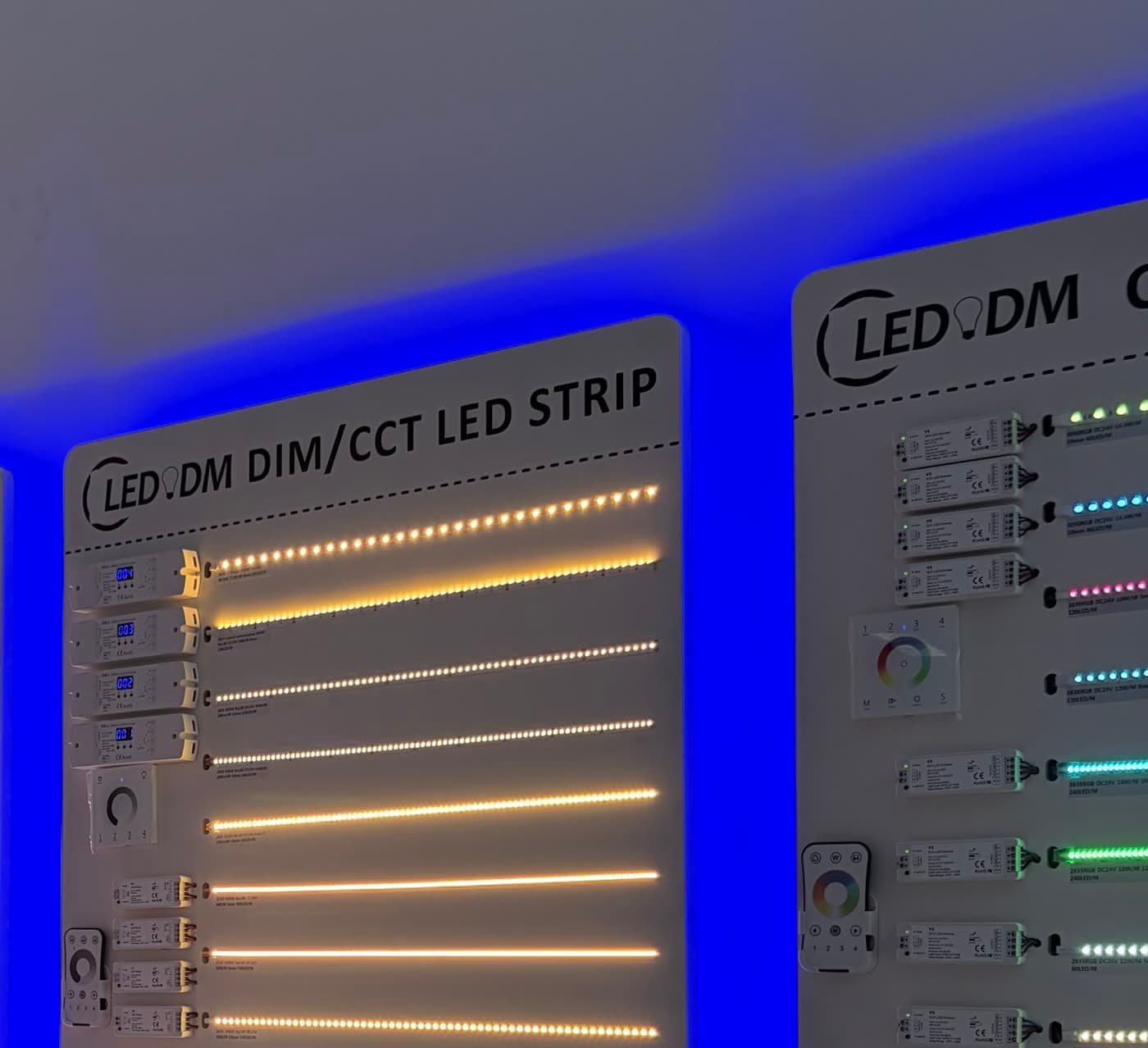
The hero shows real strip samples as a visual product reference; it is not evidence of aluminum-channel thermal performance.
Common mistakes include ordering by external width, forgetting connector space, forcing the strip around a corner, assuming any profile solves heat management, or treating the diffuser as proof of thermal suitability.
Use a compatible channel when the evaluated assembly benefits from heat transfer, mounting, protection, or optics. Omit it only when product instructions and the tested mounting condition support that choice.
FAQ
Does a diffuser replace an aluminum channel?
No. A diffuser is an optical cover; the metal profile can provide separate mounting, protection, and heat-transfer functions.
How do I check whether the strip fits?
Compare the strip and connector dimensions with the profile's internal width and depth, then test fit the complete assembly.
Can COB strip be mounted directly to furniture?
It depends on product instructions, power, duty, surface, environment, protection, and the project's evaluated installation method.