Color-architecture decision guide
| Architecture | Primary capability | What to verify |
|---|---|---|
| Single color | One fixed white or color | Voltage, CCT, one-channel load |
| Tunable White | Adjustable warm-to-cool white | Two channels, endpoints, mixing, control logic |
| RGB | Colored light from three channels | Color intent, white approximation, controller and load |
| RGBW | RGB plus a dedicated white channel | White-channel specification, four-channel capacity, scene behavior |
Bounded evaluation workflow
- Write the required scenes and decide whether accurate white light or decorative color is needed.
- Select one, two, three, or four channels before specifying the controller.
- Verify strip wiring, voltage, W/m by state, controller capacity, and supply arrangement.
- Build a representative sample and commission endpoints, mixed states, transitions, and restart behavior.
- Record approved equipment, settings, cable layout, and user-interface behavior.
This guide selects channel architecture; control protocols and dimmer compatibility are covered in the separate dimming guide. RGB does not automatically replace a dedicated white channel where white-light quality matters.
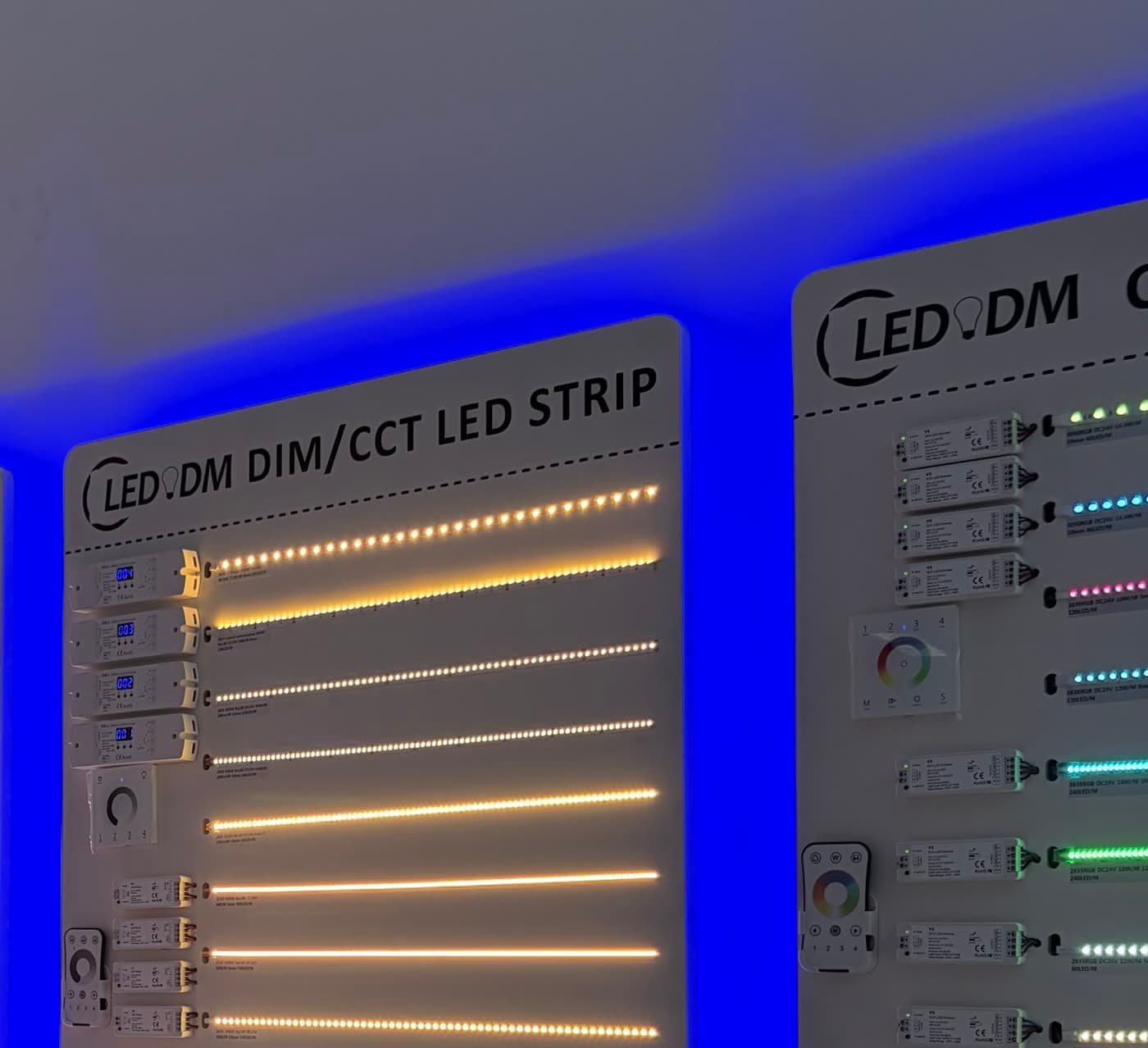
The image is illustrative and does not prove output, color accuracy, mixing, or control performance.
FAQ
Can RGB COB produce usable white light?
RGB can mix a white appearance, but projects requiring defined white quality should compare it with a dedicated white or RGBW option.
How many channels does Tunable White use?
Common systems use two white channels, but verify the exact strip wiring and controller documentation.
Is RGBW controlled like single-color COB?
No. RGBW requires compatible four-channel control and power capacity for the intended operating states.